
DISTRIBUTED MANUFACTURING TOOLING
OBJECTIVE
It all started at the beginning of the pandemic. I decided to put all my knowledge into developing biodegradable, locally manufactured face masks. My main goal was to help Chile, my home country. Together with universities and industry, we were developing wood pulp face masks. We aimed to create a high volume and low-cost manufacturing process for PPE with the means available in a country with almost nonexistent manufacturing facilities. We realized that molds were our most significant entry barrier during our work with molders. This problem was common in the industry, as they relied on rudimentary manual processes.
Forming molds rely on a stainless steel mesh that retains fiber from a slurry (water+fiber)after a water suction process; to build a molded fiber product. The manufacturing process requires manually thermoforming, cutting, and attaching the mesh to the metal base. This process results in long manufacturing lead-time and high initial investment. For this reason, tooling is usually manufactured overseas in the Asia-Pacific zone.
We needed to develop a digital process that could design and fabricate porous structures with fatigue tolerance and high load-carrying capacity. Then, even more challenging, manufacture them with machines available in Chile, at a low cost, for prototyping scale.
TECHNICAL DETAILS
Technical requierments:
| Mesh Porosity | Tensile Strength | Fatigue Tolerance |
|---|---|---|
| 5mm or US Mesh 35 | 8 Mpa | Capacity to withstand more than 100 cycles. |
This work demonstrates the feasibility of manufacturing low-cost, fast production forming molds that can withstand the process mechanical requirements and effectively drain water using affordable additive manufacturing techniques, stereolithography (SLA).
The most significant developments of these work were: A novel mold architecture that took full advantage of additive manufacturing technologies and applied micro-architected lattice material to construct fiber filtering meshes.
To identify the critical trade-off, I analyzed the state-of-the-art technologies and a feedback process with manufacturers worldwide. This research allowed me to detect weaknesses in current 3D printed solutions and standard stainless steel molds. The challenges I identified were:
- Stiffness, building stiffer meshes would require expensive materials or higher mesh thickness.
- Clogging, molds have to be able to avoid clogging, and/or be able to withstand the pressure of the cleaning process
- Water drainage, mesh thickness and the number of through-holes will directly affect the mold's capability to drain water.
- Vibration, low stiffness of meshes produce vibrations, reducing their lifespan.
RESULTS
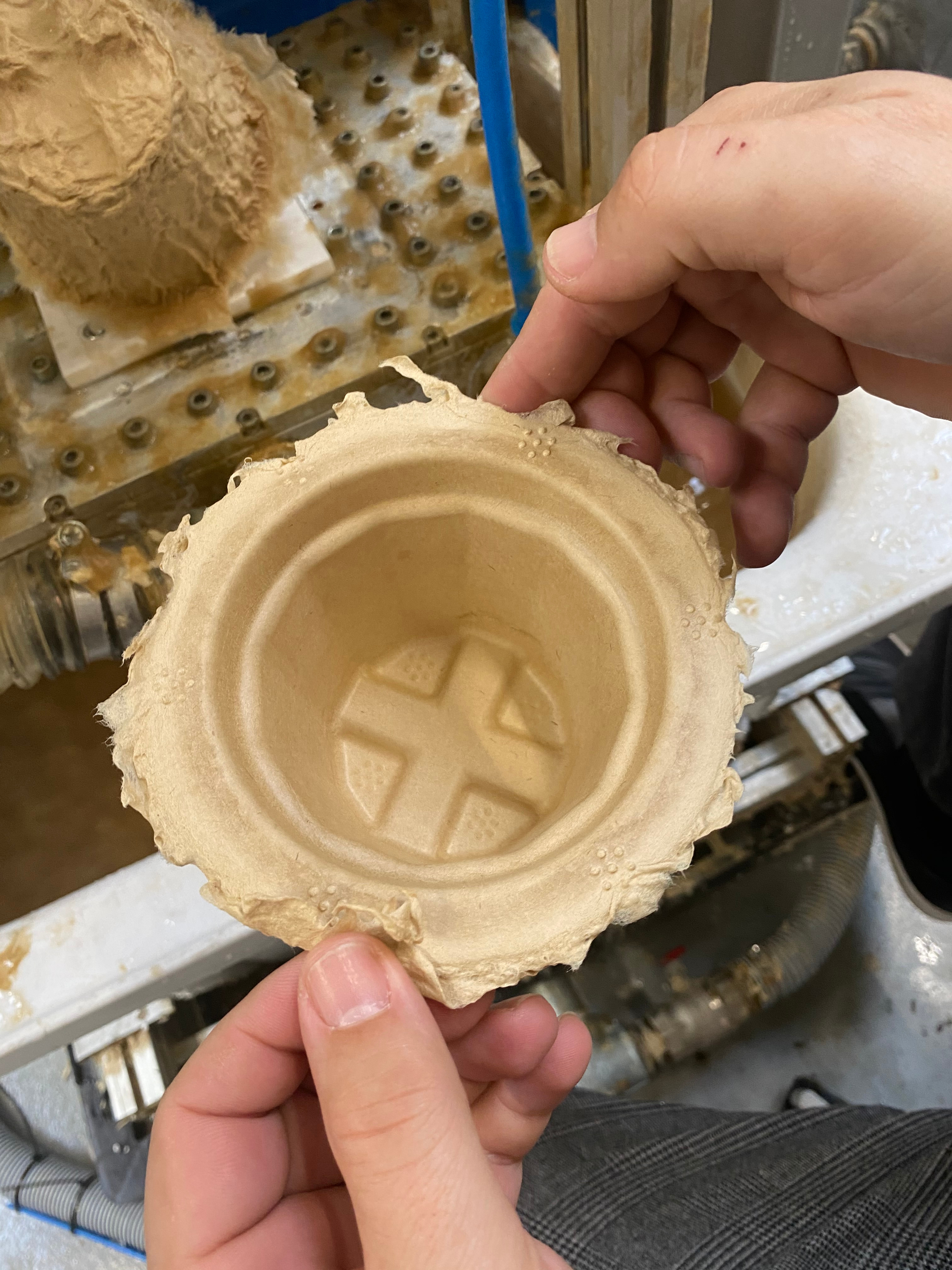
The mold’s performance was tested in the infrastructure of the International Molded Fiber Asociation and in the facilities of LeafPack in Denmark, proving it worked under industrial conditions.
Outputs:
- The work was featured in FormLabs User Summit 2021.
- Paper. Soon to be presented in the Manufacturing Science & Engineering Conference 2022. You can read the long abstract here.
- Patent. Status: Pending.